AI Receptionist for Water Treatment Companies
An AI receptionist for water treatment answers every call, captures install and service requests, and scores the CSR on every conversation handled.
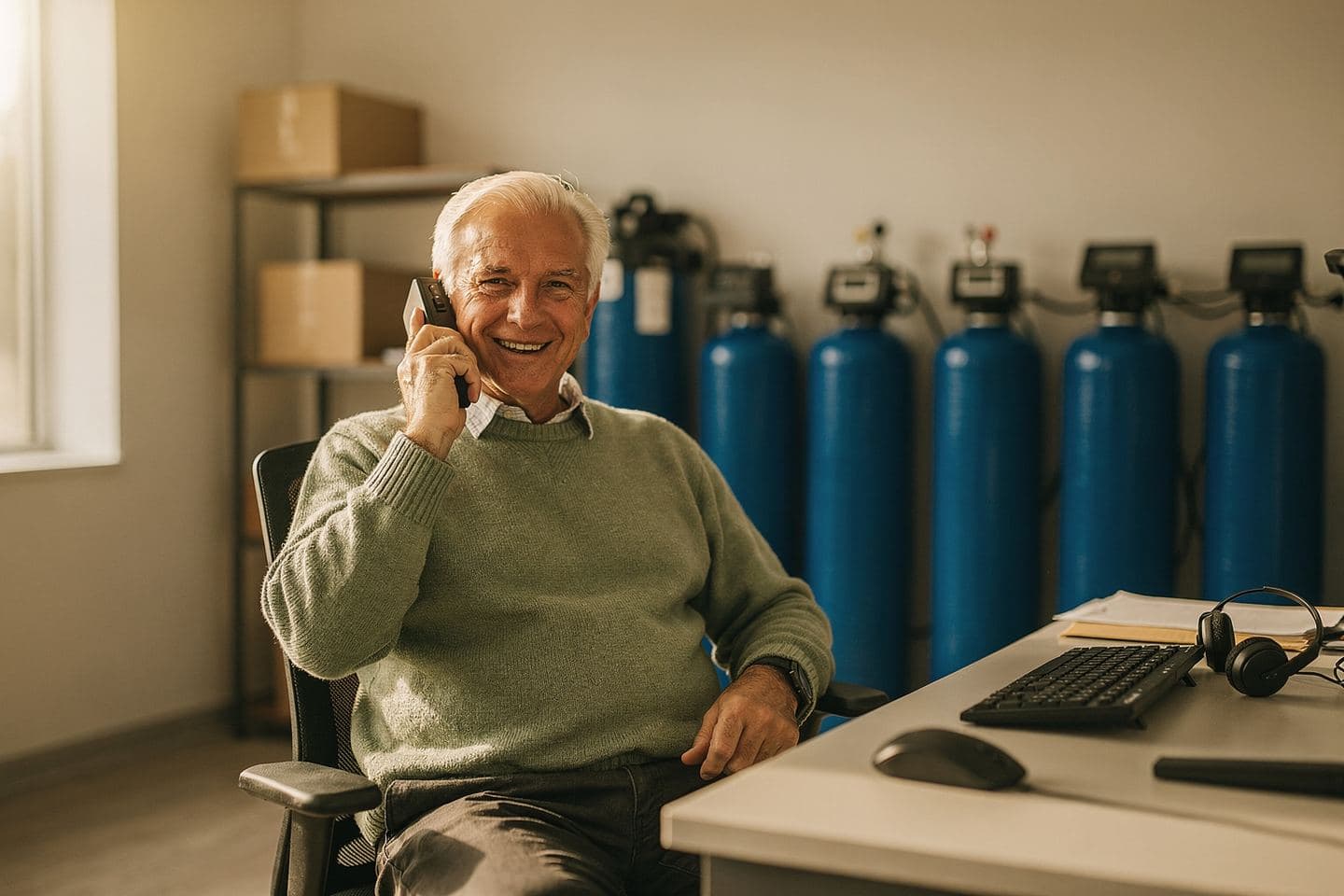
Water Treatment Businesses Lose Revenue at the Phone Every Day
An AI receptionist for water treatment answers every call, captures install and service requests, and scores the CSR on every conversation handled.
Water treatment is a recurring-revenue business: salt routes, filter replacements, regeneration visits, system checks, and periodic high-ticket installs or whole-home upgrades. The phone is where that revenue either gets captured or disappears. 27% of calls to home-services businesses go unanswered, according to Invoca, and for a business where a single softener installation runs $2,000 to $8,000, a handful of missed calls each week adds up to real money.
The problem is not that water treatment offices ignore the phone. The problem is volume and multitasking. The same CSR handling a 9 a.m. service scheduling call is often doing dispatch at 9:15, quoting a whole-home system at 9:30, and fielding a water-quality question at 9:45. Calls stack up. The busy signal gets hit. The voicemail fills. 85% of callers who cannot reach a business on the first try never call back, per Numa's 2021 Small Business Phone Report. Each unanswered call is not a delay, it is a permanent loss.
58% of inbound calls to home-services businesses never turn into a booked job, according to ServiceTitan's survey of more than 3,000 businesses. That figure covers all inbound calls: the ones someone answered and the ones that went to voicemail. For a recurring-service business where the lifetime value of a softener customer stretches across years of salt deliveries, filter swaps, and system upgrades, the gap between "called in" and "scheduled" is where margin lives.
Why Generic Answering Services Fail Water Treatment Companies
The default fallback for a busy water treatment office is a generic answering service, a human or AI that picks up the phone, takes a name and number, and sends a message to the team. That solves one problem (the call gets answered) while creating two more.
First, a generic answering service does not know the difference between a customer reporting a soft water leak, a prospect asking about a whole-home reverse osmosis system, and a commercial account with an emergency filtration issue. Every call gets treated the same: a name, a number, and a vague message. The CSR who calls back has to start discovery from scratch, often hours later, when the prospect has already called a competitor.
Second, there is no coaching. The generic answering service takes the message and stops. It does not score how well the CSR handled the callback, does not flag a winnable install call that got lost on a pricing objection, and does not give the CSR a practice scenario based on where that conversation went wrong.
Speed compounds the problem. A lead is 21x more likely to qualify when contacted within 5 minutes rather than 30, per the Oldroyd and InsideSales.com research. A Chili Piper benchmark of roughly 4 million form submissions in 2025 found that instant response produces a 66.7% meeting-booked rate versus roughly 30% for standard follow-up. A caller who reaches dead air at 8 p.m. after a neighbor mentioned their filtered water system is not waiting until Wednesday morning.
A water treatment office that runs on service agreements is in the relationship business. The first call, whether it is a new install inquiry or a cancellation call, sets the tone. A trained, scored, coached CSR converts more of those first calls into signed service agreements. A message-taking service does not build that skill.
How a Water Treatment AI Receptionist Works
Roonly Office approaches the water treatment phone problem as a full loop: answer, qualify, capture the booking request, follow up, and coach the CSR who handled the call. Each step is connected rather than siloed.
The AI receptionist sits in front of the numbers a water treatment business already publishes. Calls reach Roonly first, the receptionist handles qualification, and the call routes to the team or to the callbacks inbox with a full intake attached. No number porting, no phone system migration, no change to the customer-facing number. The overlay approach means coaching begins on the first call.
What the receptionist captures matters more than the fact that it picks up. For a water treatment inquiry, that means the caller's name and contact, whether they are a residential or commercial account, what problem they are experiencing or what system they are interested in, their preferred timing for a site visit or callback, and their urgency level. That intake arrives with the recording. The CSR who takes the handoff or calls back starts with context rather than a blank message.
Call scoring on every call means every conversation, including inbound service requests, install consultations, cancellation calls, and commercial account inquiries, gets graded on greeting, discovery, empathy, objection handling, booking ask, and call control. The score is consistent across every call, so a CSR's performance is measured the same way on a residential salt delivery call as on a commercial filtration consultation. Scores arrive in the coaching queue with specific feedback on where the call went well and where it did not.
When a CSR handles a cancellation call poorly, for example a customer citing cost who could have been saved with a service plan adjustment, Roonly flags that moment and builds a roleplay scenario around that specific objection type. The CSR practices the save before the next cancellation arrives. That is built from the company's own call data, not a generic script.
Water treatment customers who already have a softener or filtration system represent ongoing upsell opportunities: filter upgrades, salt delivery add-ons, expanded service tiers, and whole-home system consultations. Every inbound call from an existing customer is also a moment where an attentive CSR can surface one of those conversations. Call scoring captures whether that opportunity was taken or missed.
ROI Metrics for Water Treatment Companies
The math in water treatment is straightforward because the recurring model makes lifetime value easy to estimate.
| Metric | Benchmark | Source |
|---|---|---|
| Calls going unanswered | 27% of home-service calls | Invoca |
| Inbound calls that never book | 58% of all inbound calls | ServiceTitan, 3,000+ businesses |
| Callers who don't call back | 85% after one missed attempt | Numa, 2021 |
| Speed-to-lead advantage | 21x more likely to qualify in 5 min vs. 30 min | Oldroyd/InsideSales, 2007 |
| CSR replacement cost | $10,000 to $20,000 per agent | 2026 call-center roundups, CallForce/Ringly |
Sources: Invoca, ServiceTitan, Numa, Oldroyd/InsideSales, CallForce 2026
A 5-CSR water treatment office with 30 to 45% annual turnover loses roughly 1.5 to 2 CSRs per year, at a replacement cost of $10,000 to $20,000 each. That is $15,000 to $40,000 in recruiting, onboarding, and lost productivity before accounting for missed installs from a new CSR still learning the product line. A coaching system that helps CSRs improve and stay is not just a revenue tool, it is a retention tool.
For a business with high-ticket installs ($3,000 to $8,000 for a whole-home system) and recurring service agreements ($30 to $80 per month per account), answering one additional install call per week and retaining one more service customer per month pays for a phone improvement program many times over. The true cost of a missed call in a recurring-revenue business is not just the call value, it is the annualized account value.
Common Objections From Water Treatment Buyers
"Our calls are too simple; we don't need AI for scheduling."
The install consultation call is rarely simple. A prospect comparing quotes, asking about water quality testing, and deciding between a salt-based and a salt-free system needs a trained CSR, not a message-taker. Scoring those conversations reveals where CSRs close and where they lose. That applies to service calls as well, where a cancellation save or an upsell attempt is rarely scripted and often depends on how well the CSR listens.
"We already use an answering service for overflow."
An overflow answering service handles overflow but does not score the calls that land on the main team. The majority of calls are taken by in-house CSRs, and those calls are the ones most worth coaching. Roonly's overlay approach means every call, routed to the existing team or caught in overflow, goes through scoring and coaching. The team improves on the calls they take today.
"We're too small for a call coaching system."
The breakeven for call coaching is low in a recurring-revenue model. A 2-CSR water treatment office that closes one additional install per month because a CSR improved at the pricing objection conversation has already covered a meaningful portion of operating costs. Small teams also have less redundancy, which means each CSR's skill gap has proportionally more impact.
A Day in the Life: Water Treatment Office Manager
6:47 a.m. A homeowner calls about a discolored water issue. The office is not open yet. The AI receptionist answers, captures the caller's name, address, water problem description, and preferred callback time, and routes it to the callbacks inbox with a recording attached.
8:15 a.m. The office opens. The office manager reviews the overnight inbox: two service requests, one potential install inquiry from a caller asking about well water filtration options, and one customer who called to cancel a salt delivery subscription. The cancellation recording has a flag: the caller mentioned the cost, and the CSR who took the message did not attempt a save or offer an alternative plan.
9:30 a.m. A newer CSR takes her first install inquiry call of the day. The call is scored automatically. Her discovery questions rated well; her close rated below average. The coaching feedback appears in her queue within the hour.
11:00 a.m. The office manager checks the call log. Yesterday's calls include a score distribution across the team. One CSR is consistently underperforming on objection handling related to system cost. A roleplay scenario built from a real cost-objection call is queued for that CSR's next practice session.
3:00 p.m. A commercial account calls about a filtration contract for a food service facility. The AI receptionist qualifies it as a commercial inquiry and routes it to the commercial team. The call is recorded and scored with a commercial rubric separate from the residential queue.
What to Look for in an AI Phone System for Water Treatment
Not every AI receptionist is the same, and a water treatment business should evaluate on more than whether it answers the phone. Here is what matters:
- Qualification depth: Does the receptionist capture enough context for a water treatment callback to be productive? A name and number is not enough; the type of issue, system interest, residential versus commercial, and urgency all matter.
- Call scoring on all calls, not just missed calls: An AI that only handles overflow misses the calls your team is already taking poorly. Every call should be scored.
- CSR coaching from call data: Post-call grading is the lever that improves the team over time. A phone system that just answers and captures does not solve the skill problem.
- Overlay compatibility: A water treatment office that already has a phone system should not have to replace it. Look for a system that works in front of the phones you already publish.
- CRM writeback: After every call, the outcome and recording link should land in the CRM without a rep logging it manually.
- No porting required to start: The cost and delay of number porting is not a reasonable barrier to starting call coaching. Overlay should be available from day one.
Roonly Office plugs into the CRM and phone system you already run, starts recording from the first call, and adds coaching without requiring a platform migration. For water treatment companies that run a mix of phone systems and CRMs, the phone-system-agnostic approach matters: Roonly ingests calls from more than 10 phone platforms via webhook and direct integration.
Frequently Asked Questions
Can an AI receptionist handle the technical questions water treatment customers ask?
Yes, with proper setup. An AI receptionist trained on the company's service descriptions, common water quality questions, and product information handles the initial intake accurately. For complex technical questions, such as specific well chemistry or industrial treatment specifications, the standard approach is to capture the inquiry and route it to a specialist. The receptionist is built to say "I will have our water quality specialist call you back" rather than attempt a technical answer it cannot verify.
Does Roonly Office work with the phone system a water treatment company already has?
Roonly offers overlay capture, which means it sits in front of the numbers a business already publishes. Calls reach Roonly first, get recorded and qualified, and then route to the existing phone system or team. No porting is required. This works with VoIP systems, landlines, and most small-business phone platforms.
Does the AI receptionist cover after-hours and weekend calls?
Yes. After-hours and weekend coverage is a live feature. The receptionist answers when the team cannot, captures service requests and install inquiries with full intake, and routes everything to the callbacks inbox. For a water treatment business that receives emergency water quality calls outside business hours, after-hours capture is often the most immediate operational improvement.
How does call scoring work for water treatment calls?
Every ingested call is scored automatically on a rubric covering greeting, discovery questions, empathy, value communication, objection handling, booking ask, and call control. The rubric is consistent across every call, so a CSR's performance is measured the same way on a residential salt delivery call as on a commercial filtration consultation. Scores arrive in the coaching queue with specific feedback on what went well and what did not.
What happens when a customer calls to cancel a service agreement?
The call is answered, recorded, and scored. If the cancellation includes a recoverable objection (price, service quality, moving, etc.), that moment is flagged in the call review. The CSR who took the call receives a coaching note and a roleplay scenario built around that objection type. Roonly is also built to surface churned customers and draft recovery follow-up grounded in the recorded conversation, with autonomous sending rolling out.
Does Roonly integrate with CRMs used by water treatment companies?
Roonly writes call outcomes and recording links directly to CRM contacts after every scored call. For water treatment companies using CRMs with a supported integration, that writeback happens automatically after each analyzed call. For companies on other platforms, Roonly supports a generic webhook path for any phone system that can send a webhook, and direct connectors are built on request.
How long does it take to set up?
Overlay capture is the fastest path. The business keeps its existing numbers and phone system; calls forward through a Roonly number, and recording and scoring start on the first call. Most setups do not require a carrier change or number porting, which means the coaching loop starts immediately rather than after a migration window.
Related guides



Last updated August 10, 2026.
See what Roonly finds in your team's conversations.
Roonly coaches every in-person sales conversation and trains each rep on exactly where they lose the sale.
Book a demo