What Is an AI Receptionist?
An AI receptionist answers calls automatically, qualifies callers, captures booking requests, and routes to live staff, with no hold times or voicemail.
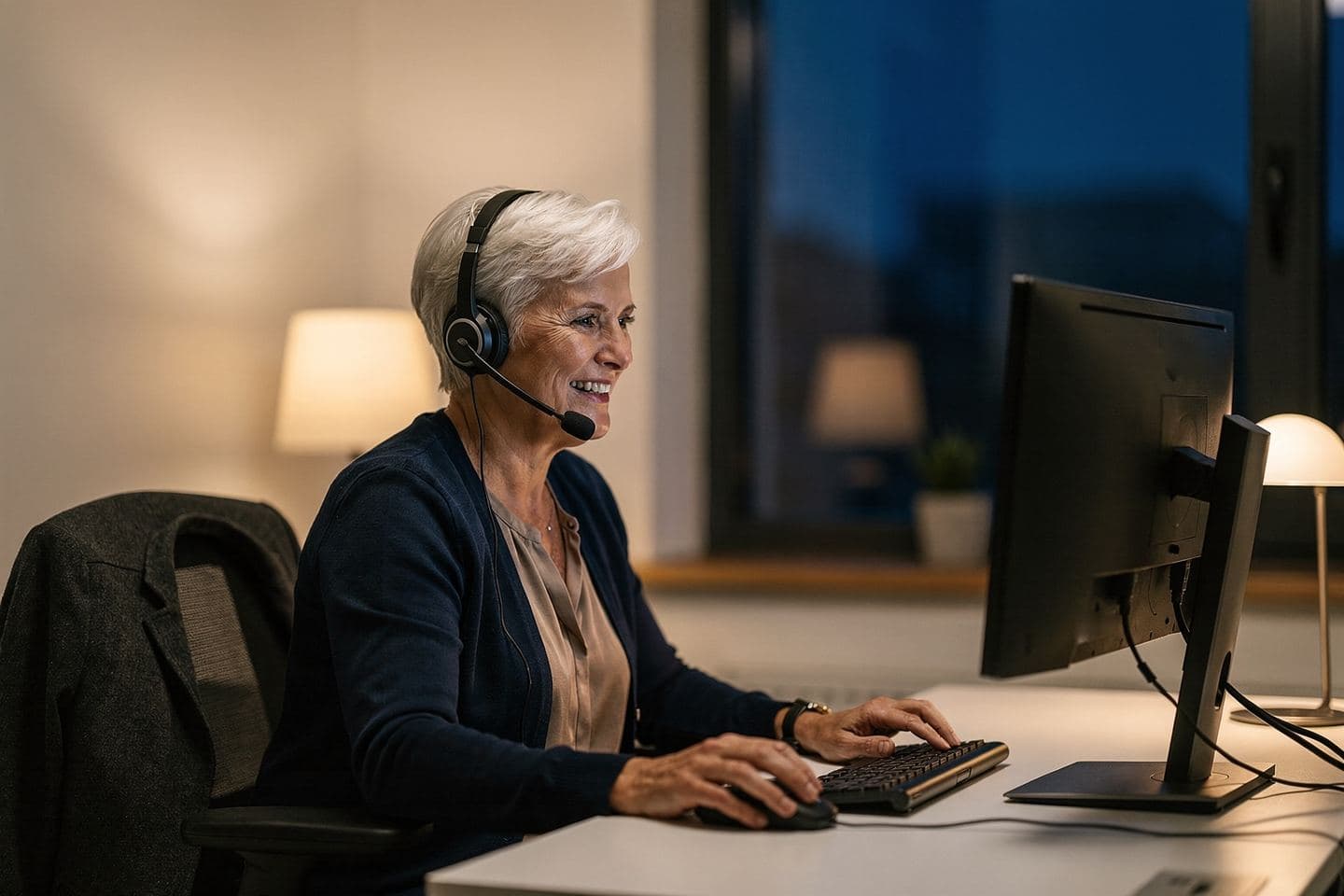
What Is an AI Receptionist?
An AI receptionist answers calls automatically, qualifies callers, captures booking requests, and routes to live staff, with no hold times or voicemail.
An AI receptionist is a software-based system that answers your business phone line, understands what each caller needs through voice AI and natural language processing, and routes them to a live person when the conversation calls for it. Unlike a voicemail box or a recorded menu, an AI receptionist holds a real back-and-forth conversation: it asks for the caller's name, the service they need, and their preferred timing, then decides in real time whether to transfer the call, take a message, or answer the question itself.
For a home-services business, that distinction matters. A caller with a termite problem or a broken furnace expects a conversation, not a phone tree. An AI receptionist can handle those calls using language trained on the business's own service area, service types, and common questions. It answers on the first ring, at 2 a.m., and when every CSR on staff is already on the phone with another customer.
Why Unanswered Calls Cost Home-Services Offices More Than They Think
The phone is still how most home-services customers choose a vendor. They find three businesses, call whichever answers first, and book with whoever helps them. When a business fails to answer, that lead rarely comes back: 85% of callers who cannot reach a business on the first try never call back (Numa, Small Business Phone Report, 2021).
The missed-call rate for the industry is significant. 27% of calls to home-services businesses go unanswered (Invoca), and the problem does not stop at answered calls. Even among the calls that connect to a live CSR, 58% of all inbound calls to home-services shops never turn into a booked job (ServiceTitan, analysis of 3,000+ businesses). Unanswered calls are a floor problem. Conversion after answering is a coaching problem. Both are fixable, but they require different tools.
Speed compounds the loss further. A lead is 21x more likely to qualify when contacted within five minutes rather than 30 (Oldroyd, InsideSales.com / MIT Lead Response Management Study, 2007). Every minute of hold time, every voicemail, and every after-hours no-answer pushes a prospect closer to booking with whoever picked up. The true cost of a missed call for a home-services office extends well beyond a single unanswered ring.
How an AI Receptionist Works in Practice
A caller dials the business's existing phone number. Depending on configuration, the number either forwards to the AI system or rings through it first. The AI answers on the first or second ring, greets the caller by the business name, and begins a natural conversation.
A typical inbound flow for a pest-control office might work like this: the caller says there are ants in the kitchen. The AI confirms the address is within the service area, asks whether they are a current customer, captures the best time for a technician visit, confirms a callback number, and asks if they have questions about the service. If the caller asks for a price range, the AI answers with what the business has configured. If the caller asks to speak to someone directly, the AI transfers the call immediately.
The outcome lands in a callbacks inbox, or with a direct CRM integration, straight into the contact record in the field-management software. The CSR who picks up the next morning does not have to listen to a voicemail and transcribe it by hand. The lead is already filed with the caller's name, issue, address, and preferred time.
After-hours coverage is the most immediate win. A business that closes at 5 p.m. still gets calls at 7 and 9 p.m. A homeowner who discovers a roof leak on a Saturday is not going to wait until Monday. An AI receptionist that handles those calls and files them as actionable leads, rather than routing to voicemail, recovers revenue the business was losing before it even knew.
Key Benchmarks: What the Numbers Say About Phone Performance
These benchmarks apply to the home-services front desk. They establish a baseline for understanding what an AI receptionist changes, and what it does not.
| Metric | Without AI coverage | With AI receptionist |
|---|---|---|
| Calls answered | ~73% (27% missed) | Near 100% during and after hours |
| After-hours lead capture | Voicemail or zero | Fully captured and filed |
| Speed to first response | Minutes to hours | First ring, 24/7 |
| CSR time on routine intake | High (manual, every call) | Reduced for AI-handled calls |
| Inbound-to-booked rate | ~42% of all calls | Improves as fewer leads fall to voicemail |
Sources: Invoca (27% unanswered); ServiceTitan (58% of all inbound calls never book, 3,000+ businesses surveyed); Numa 2021 (85% of missed callers do not call back).
Staffing cost is another lens on this calculation. CSR turnover in contact-center roles runs at 30 to 45% annually (2026 call-center attrition data, CallForce and Ringly roundups), with each replacement costing an estimated $10,000 to $20,000 in recruiting, training, and ramp time. A human receptionist earns roughly $17.90 per hour at the median, or around $37,000 per year before benefits (Bureau of Labor Statistics, OES May 2024). An AI layer that handles high-volume routine intake does not replace the CSR, but it reduces the cognitive load on the front desk and means that every seat matters more.
How AI Phone Systems Like Roonly Office Go Beyond Answering
Most AI receptionists end at the answered call. They route, take a message, or capture a booking request, and that is the extent of the improvement. Roonly Office is built around a different design: the answered call is where the loop begins, not where it ends.
After every call, Roonly scores the conversation on greeting, discovery, empathy, objection handling, and booking ask. The CSR who handled the call gets specific feedback tied to what actually happened on that conversation, not a generic rubric. If a caller was qualified and ready to book but the CSR failed to make the ask, that moment is flagged. If a caller raised a price objection and the CSR had no response, that objection becomes a practice scenario.
Call scoring on every call is what separates a phone tool from a coaching tool. The first category answers the phone. The second answers the phone and makes the team measurably better over time.
The overlay model also deserves attention here. Many businesses cannot or do not want to port their existing numbers or switch phone carriers. Roonly Office can sit in front of the phone system a business already uses, recording and scoring calls and routing them onward, without any number migration required. It works in front of systems with no open API, and caller ID passes through so the existing CRM screen-pop continues to function.
For home-services businesses using FieldRoutes or JobNimbus, Roonly writes the outcome, score, and a recording link back to the CRM after every call automatically. The FieldRoutes integration works with no phone migration, meaning a business can add call scoring without leaving the phone system it already runs. No manual note entry, no dropped leads.
Common Misconceptions About AI Receptionists
"It sounds robotic and customers will hang up." Voice AI has improved considerably. The caller experience depends on configuration: voice selection, script tone, and how gracefully the system handles unexpected input all matter. A well-configured AI receptionist, trained on the business's own service types and common questions, sounds closer to a composed CSR than to a phone tree.
"It books the appointment for me." Most AI receptionists, including the majority of systems reviewed in industry buying guides, capture the caller's preferred time and file a booking request. They do not write a confirmed appointment to the calendar in real time in most implementations. Confirm the specific integration before purchasing.
"It replaces my CSR." An AI receptionist is an overflow and after-hours layer in most home-services configurations, not a full CSR replacement. The most common setup is team-first: calls ring the CSR team during business hours, and the AI catches only what the team cannot. AI-first configurations, where the AI answers every call and transfers to a human when asked, are available but not the default recommendation for most offices.
"Any AI receptionist will work for my trade." Generic AI receptionists are not trained on home-services language, service types, service areas, or pricing. A home-services business gets better results from a system that can accurately answer "do you treat mosquitoes?" or "is my zip code in your service area?" Systems built for generic businesses often fall back to unhelpful responses on trade-specific questions.
"Coaching is a separate product." For most vendors, it is. An AI receptionist that only answers calls leaves the business with the same conversion problem on the calls that do connect. Understanding which products stop at answering and which also score and coach the CSR is the most consequential distinction when evaluating options.
Frequently Asked Questions
What is the difference between an AI receptionist and a virtual receptionist?
A virtual receptionist is a human working remotely on behalf of the business, answering calls with a personal touch. An AI receptionist is software that handles calls automatically. Human virtual receptionists handle edge cases more flexibly; AI receptionists are available 24/7 at lower cost per call and scale without adding headcount.
Can an AI receptionist book appointments?
Most AI receptionists capture the caller's preferred time and file a booking request. Whether that request writes directly to the business's calendar or CRM in real time depends on the specific system and its integrations. Confirm integration depth before selecting a vendor.
Will callers know they are talking to an AI?
Policies vary by vendor and jurisdiction. Some businesses configure their AI to identify itself as an automated assistant at the start of the call; others do not. Disclosure practices are evolving alongside regulations in some states, so verify the vendor's default configuration and your local requirements.
Does an AI receptionist work after hours?
Yes. After-hours coverage is typically the primary use case. The AI answers calls when the CSR team is unavailable, captures the request, and files it as a lead or callback task for the next business day.
How does an AI receptionist handle a caller who wants to speak to a person?
A properly configured AI receptionist transfers the call immediately when asked. During business hours this reaches the CSR team; after hours, the system can offer to take a message or confirm a callback.
What happens if an AI receptionist cannot answer the caller's question?
The system should fall back to a human transfer or message capture, not leave the caller in a dead end. Verify that any system you evaluate has a defined failure mode that ends in a captured lead rather than a dropped call.
How is an AI receptionist different from an AI phone system with call coaching?
An AI receptionist answers calls. An AI phone system with call scoring and coaching also analyzes every conversation, grades CSR performance on specific criteria, and surfaces practice scenarios built from the rep's real calls. Systems designed to run the full loop, like Roonly Office, are built to answer the phone and make the human who took the call better over time, rather than stopping at the answered call.
Related guides




Last updated August 12, 2026.
See what Roonly finds in your team's conversations.
Roonly coaches every in-person sales conversation and trains each rep on exactly where they lose the sale.
Book a demo