After Hours Answering Service for Home Services
An after hours answering service for home services captures calls when CSRs are off, qualifies callers, and logs booking requests automatically.
What Happens Without an After Hours Answering Service
An after hours answering service for home services captures calls when CSRs are off, qualifies callers, and logs booking requests automatically.
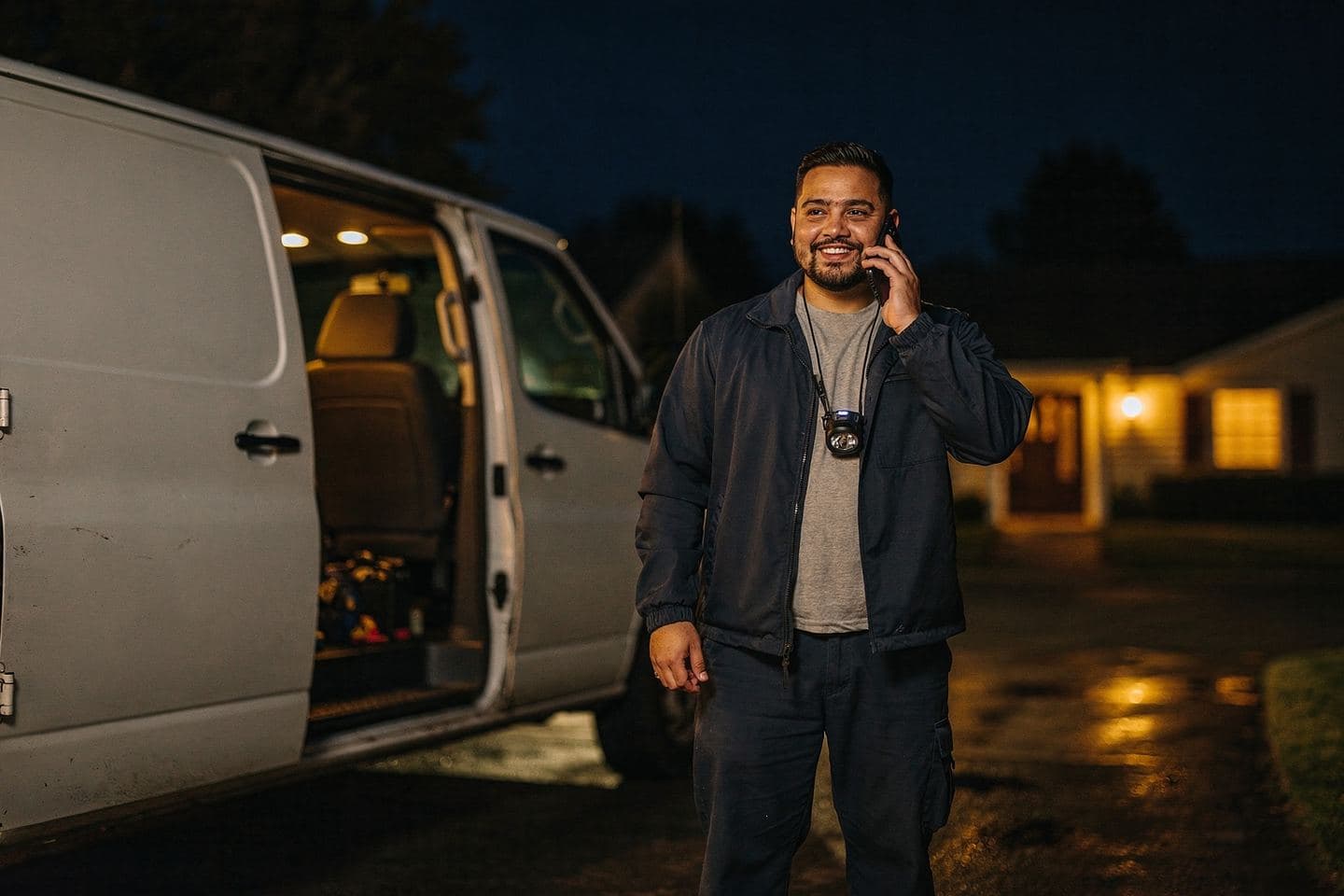
When a homeowner's AC fails at 8 PM on a Friday, they call the first contractor who picks up. If your office is closed and voicemail catches that call, you probably lost the job before 9 PM. That homeowner did not leave a message and wait. They called the next number on their search results.
The pattern repeats thousands of times a day across pest control, HVAC, roofing, and plumbing shops. 27% of inbound calls to home-services businesses go unanswered (Invoca). A meaningful share of those unanswered calls fall after regular business hours, and emergency calls, which carry the highest ticket values, disproportionately arrive at night and on weekends, precisely when no one is staffed to answer.
The math compounds fast. 85% of callers who cannot reach a business on the first try never call back (Numa, Small Business Phone Report, 2021). They do not leave a voicemail and wait until morning. They move on. By the time a CSR calls back at 9 AM, the job is already scheduled with someone else.
Voicemail is not an after hours answering service. Neither is an on-call CSR whose phone rings at 11 PM. Both options create friction for the team, produce incomplete records, and generate callbacks without context. The real cost is not just the missed call. It is the missed opportunity to qualify, capture, and log that lead before a competitor gets there.
Beyond individual calls, 58% of inbound calls to home-services businesses never convert to a booked job across all hours of the day (ServiceTitan, survey of 3,000+ businesses). After-hours calls that go to voicemail contribute a clean zero-percent to that conversion rate, pulling the whole number down before a CSR ever picks up the phone. The gap between a business that answers after hours and one that does not shows up in the booking rate first and the revenue report second.
How Roonly Office Works as an After Hours Answering Service
Roonly Office runs an AI receptionist that answers calls around the clock, with no on-call burden on the team. You configure when and how the AI steps in. Two modes are available: AI-first (every call is answered by the receptionist immediately, then transferred to a live CSR when one is on the floor) or team-first (CSRs get the call during business hours, and the AI catches everything that goes unanswered, after hours, or during overflow when multiple callers ring at once).
When a caller reaches the AI receptionist outside business hours, the call is handled end to end. The AI receptionist qualifies and books by greeting the caller, capturing their name, the nature of the problem, urgency level, service address, and preferred callback window. It answers common questions about services and pricing the way a trained CSR would, because it is trained on the company's own call transcripts and business profile, not a generic template. If the caller asks to speak with a person, they are transferred.
Every after-hours call produces a structured record in the CRM before the first CSR arrives in the morning: the caller's contact details, the reason for the call, urgency level, and a link to the recording. The callbacks inbox is populated and prioritized. The CSR opens it, not a voicemail folder.
The overlay setup makes this low-friction to start. Roonly can sit in front of the numbers a business already publishes, meaning no porting, no carrier change, and no new number to update in ads, on trucks, or in directory listings. Calls reach Roonly first, get answered or forwarded according to the schedule the business sets, and the existing caller ID passes through so any screen-pop the team already uses keeps working. You can read more about how Roonly Office connects to the phone system and CRM you already run in its overview.
How It Works: Five Steps From Ring to Ready Callback
Step 1: Forward or overlay on the number you already have. Set up conditional call forwarding from the number the business publishes, or place Roonly in the call path as an overlay. No porting is required to get started.
Step 2: The AI receptionist answers immediately. During after-hours windows the business defines, the AI greets every caller without rings to voicemail, without hold music, without dead air. Multiple simultaneous callers are handled at once, so a surge of storm-damage calls does not land in voicemail because two CSRs are already on the phone.
Step 3: The AI qualifies and captures. The receptionist asks for name, problem description, urgency, service address, and callback preference. It answers questions about services, pricing ranges, and scheduling using the company's actual language. For calls requiring an in-person estimate, it funnels the caller toward a confirmed visit rather than quoting a price.
Step 4: Every call is logged to the CRM. After the conversation closes, Roonly finds or creates the contact in FieldRoutes or JobNimbus and writes a note with the call outcome, a recording link, and a score. The morning CSR sees a structured list, sorted by urgency, rather than a pile of voicemails to decode. Direct CRM writeback requires no middleware or Zapier.
Step 5: Every call is scored and ready for review. The after-hours call, including the AI-handled intake, is transcribed and scored against the office rubric. When the morning callback happens, that call is scored too. Call scoring on every call shows managers where the after-hours pipeline is winning or losing, not just how many calls came in.
Industry Benchmarks: The After-Hours Call Gap
The data on after-hours call handling is consistent and worth reviewing before deciding whether the problem is worth solving.
27% of inbound calls go unanswered across home-services businesses on average (Invoca). Industry call tracking data points to 35 to 45% of home-service calls arriving during off-hours, which means a significant share of the unanswered 27% falls outside business hours. Emergency and high-urgency calls, the ones with the highest revenue per job, cluster heavily in evenings and on weekends.
85% of callers who cannot reach a business on the first try never call back (Numa, 2021). This is the number that makes voicemail expensive. A caller who hits voicemail is not a lead in a queue. They are, statistically, a lost job.
The speed of response compounds the problem further. The 2007 Oldroyd and InsideSales.com Lead Response Management Study found a lead is 21x more likely to qualify when contacted within 5 minutes versus 30. Chili Piper's 2025 benchmark of approximately 4 million form submissions found instant response produces a 66.7% meeting-booked rate versus about 30% for standard follow-up. For after-hours calls, the response window shifts to the next morning, but the first callback still tends to win. A CSR who calls back at 8:05 AM with a complete record of what the caller said beats a CSR calling at 10:30 AM after working through a voicemail backlog.
The true cost of a missed call for a home-services office stacks these effects. Each unanswered call is not just a lost booking. It is a potential customer who now knows a competitor answered when you did not.
| Approach | Who Answers | CRM Record | Call Scored | CSR Coached |
|---|---|---|---|---|
| Voicemail | Nobody | No | No | No |
| On-call CSR | One person, after hours | Inconsistent | No | No |
| Human answering service (Ruby, Nexa) | Outsourced agent | Emailed message only | No | No |
| Generic AI receptionist (Rosie, Goodcall) | Generic AI | Depends on integration | No | No |
| Roonly Office | AI, trained on your calls | Yes, every call | Yes | Yes |
Sources: Invoca, 2023; Numa Small Business Phone Report, 2021; Chili Piper Benchmark Report, 2025
After Hours Answering Service Options Compared
Voicemail
Every contractor has it. Almost no one calls back from it promptly. Voicemail captures the caller only if they choose to leave a message, and many do not. There is no qualification, no CRM log, and no score. The CSR spends the first hour of the morning listening and transcribing. Voicemail is free, and it costs a percentage of every night's inbound revenue.
On-call CSRs
Asking a team member to cover after-hours calls is the most common stopgap. It is also among the conditions most associated with CSR burnout and turnover. CSR annual turnover already runs 30 to 45% in home-services offices, and 55 to 60% in high-stress environments (2026 call-center-attrition roundups, CallForce and Ringly). Replacing a CSR costs $10,000 to $20,000 in recruiting, onboarding, and lost productivity, according to 2026 industry benchmarks. Adding an on-call burden accelerates churn among the team members handling it most.
On-call coverage also has no systematic logging or scoring. The after-hours call exists in a text message or a personal notebook until someone transfers it to the CRM, when it gets there at all.
Human answering services
Ruby starts at $250/month for 50 minutes. Nexa runs approximately $239/month for 100 minutes, with per-minute overage charges. Smith.ai's human answering service starts at $292.50/month for 30 calls. These services answer and take a message. The message arrives by email or text.
What they do not do: qualify the caller against the company's rubric, write to the CRM automatically, score the call, coach the CSR who handles the callback, or flag the calls where the morning follow-up went wrong. The interaction ends at the message. Everything after it is a manual process.
Generic AI receptionists
Rosie starts at $49/month for 250 minutes, with in-call booking and live transfers available only at its higher tier. Goodcall runs $79 to $249/month. These services answer calls using pre-built or generic templates. They are not trained on the company's own transcripts, do not score the call, and have no coaching engine connected to what happens after the call is over.
Where Roonly Office is different
Most after-hours answering tools are point solutions. They solve one part of the problem and stop. Roonly is the front of a loop: the call is answered and qualified, the lead is logged to the CRM, and the call is scored so the CSR who handles the morning callback is coached based on what actually happened. The distinction is not just better answering. It is a closed loop from the first ring to the follow-up appointment.
Who Benefits Most from After-Hours Answering
Office managers at 2 to 15 CSR shops. The offices most exposed to after-hours revenue loss are mid-size: large enough to have a meaningful call volume but too small to staff a dedicated evening or weekend shift. An office manager at a six-CSR pest shop or an eight-CSR roofing office can turn on after-hours AI answering without adding headcount or creating an on-call rotation.
Owners running seasonal operations with lean staffing windows. A pest shop that runs with half the staff in January still takes calls for bed bugs, rodents, and wildlife at all hours. After-hours answering coverage means no inbound lead is wasted during the months the office is running at reduced capacity.
CSRs who are currently on call. Removing the on-call burden directly reduces one of the working conditions most correlated with CSR turnover. A team member who knows after-hours calls are handled without their phone ringing is less likely to leave for a competitor offering regular hours.
Any shop where emergency calls arrive after hours. HVAC and plumbing see after-hours emergency calls that represent some of the highest-ticket, most conversion-ready inbound traffic in home services. These callers have an immediate need and are ready to book with whoever answers first. After-hours AI answering is not a nice-to-have for these shops. It is the infrastructure that captures the revenue the office hours model consistently leaves behind.
Frequently Asked Questions
What is an after hours answering service for home services businesses?
An after-hours answering service answers inbound calls when a business's CSRs are unavailable, covering evenings, weekends, and holidays. AI-powered services, like Roonly Office, qualify the caller, capture the booking request, and log the call to the CRM automatically. Human services take a message and send it by email or text. The difference shows up in how actionable the next morning's callbacks are.
Does Roonly Office replace CSRs for after-hours calls?
It handles the inbound intake so no CSR has to be on call. The AI receptionist captures the caller's information, answers common questions, and gets the booking request into the CRM. The CSR handles the confirmation callback during business hours, armed with full context already in the system. Roonly's approach is to keep the human CSR and make their job easier, not to replace them.
Do callers know they are speaking with an AI?
Roonly is transparent about this. The receptionist is an AI, and callers who ask are told so. Most homeowners calling with an urgent pest or HVAC problem care about whether their issue is captured and followed up, not whether the voice belongs to a person or a system. The AI handles the intake and qualification. The CSR handles the relationship.
Does setting up after-hours answering require porting a phone number?
No. Roonly can sit in front of the numbers a business already publishes using conditional call forwarding or overlay setup. Calls ring the existing system first during business hours, and the after-hours window forwards to Roonly automatically on the schedule the business sets. No number change, no carrier switch, and no update to ads, truck wraps, or directory listings.
How does after-hours call data get into the CRM?
After every call, Roonly finds or creates the contact in the CRM (FieldRoutes and JobNimbus are live-verified) and writes a note with the call outcome, urgency level, a recording link, and a score. The morning CSR opens a structured callbacks inbox rather than a voicemail backlog. No manual data entry is required.
What happens if the caller asks to speak with a real person after hours?
The AI transfers the caller when one is available. For after-hours calls when no live CSR is on the floor, Roonly captures the caller's information and the request, and logs a callback task in the CRM. The call is not lost. It is documented and queued for the first available CSR.
Is the AI receptionist trained on my business or on generic call scripts?
The receptionist is trained on the company's own call transcripts and business profile. It answers questions about services, pricing, and scheduling using the company's actual language and the way trained CSRs at that shop typically handle those questions. That grounding is what distinguishes it from generic AI receptionists that apply one-size scripts to every industry and caller type.
Related guides


Last updated August 3, 2026.
See what Roonly finds in your team's conversations.
Roonly coaches every in-person sales conversation and trains each rep on exactly where they lose the sale.
Book a demo