D2D Sales Script Examples That Close
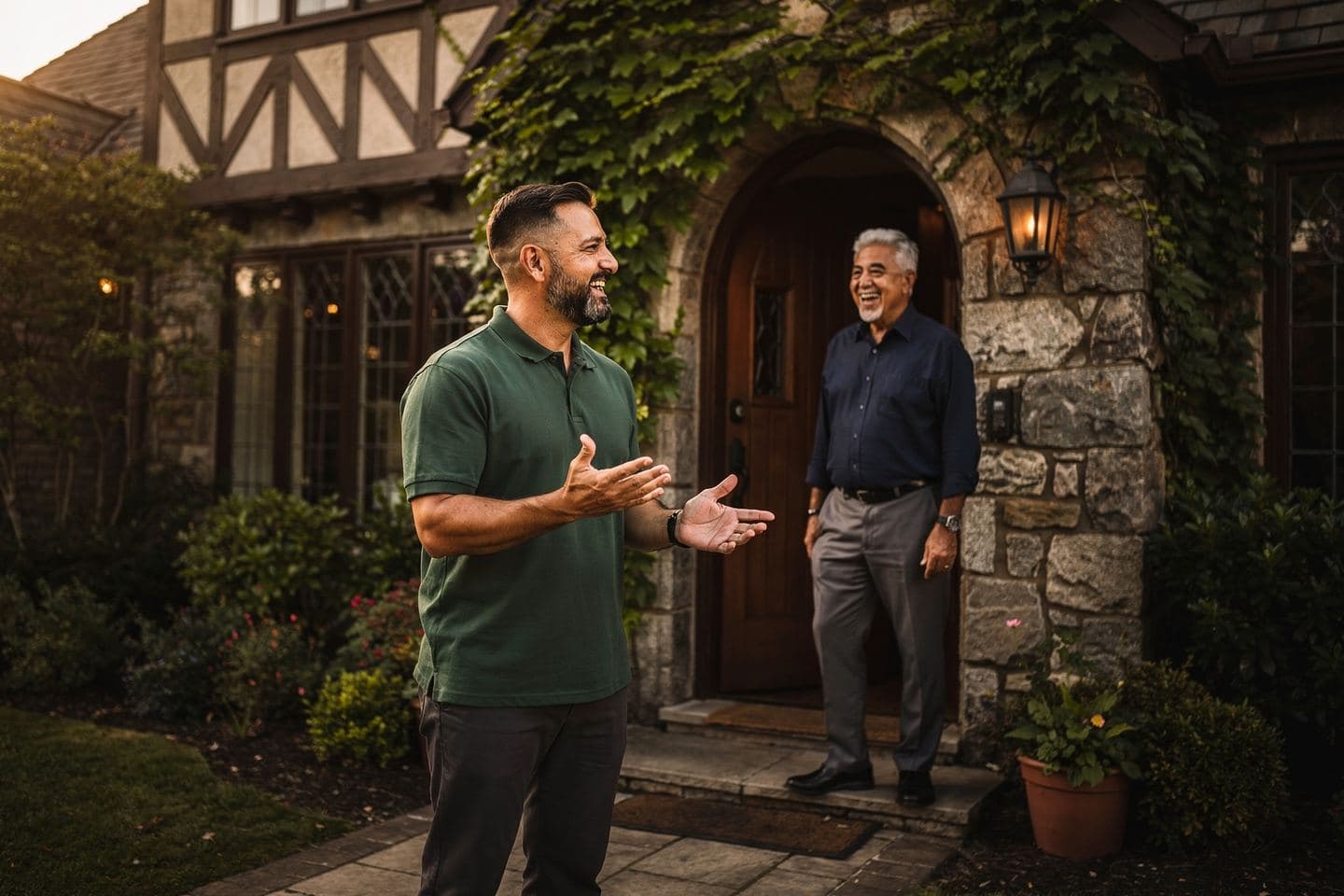
A door to door sales script is a structured conversation framework covering opener, value prop, objection handling, and close that reps adapt to each doorstep interaction.
What Is a Door to Door Sales Script?
A door to door sales script is a structured conversation framework covering opener, value prop, objection handling, and close that reps adapt to each doorstep interaction.
Unlike a word-for-word telemarketing script, a D2D sales script works more like a roadmap. It gives reps a proven structure for each stage of the conversation while leaving room to read the homeowner, adjust tone, and respond naturally. The best scripts are not memorized lines. They are internalized frameworks that a rep can pull from without sounding robotic.
Door to door sales script examples matter because the doorstep is unforgiving. Reps have roughly 10 to 30 seconds before a homeowner decides whether to keep listening or close the door. According to SPOTIO, the average D2D rep knocks 50 to 70 doors per day with a contact rate of 30-40%. That means most reps get 15 to 28 actual conversations daily. A strong script ensures every one of those conversations follows a high-conversion path.
Why Scripts Matter for D2D Sales Teams
Scripts solve the consistency problem that plagues every field sales organization. Without a defined framework, each rep improvises. Some stumble through openers. Others rush past the value proposition. Many freeze when a homeowner raises an objection they have not rehearsed.
The numbers tell the story. According to research by Invesp, 60% of prospects say "no" four times before saying "yes". Reps without a script for handling repeated objections give up too early. Meanwhile, sellers who successfully defend their product against objections achieve close rates as high as 64%, per MaxContact's analysis of 800,000 sales calls.
For managers, scripts also create a shared language. When every rep follows the same stage structure, it becomes possible to diagnose where deals break down. Is the team losing people at the opener? During the price conversation? At the close? Without a common framework, diagnosing team-wide patterns is guesswork.
The D2D industry generates over $208.5 billion globally as of 2025, according to Knockio. Teams that operate on repeatable, testable scripts consistently outperform teams that rely on individual talent alone.
How D2D Sales Scripts Work in Practice
A functional door to door sales script has five stages. Each stage has a specific goal, and the script provides language to accomplish it. Here are door to door sales script examples broken down by stage, with templates for common home services verticals.
Stage 1: The Opener (First 10 Seconds)
The opener exists to stop the door from closing. It needs to be casual, non-threatening, and relevant. The worst openers sound like a pitch. The best sound like a neighbor stopping by.
| Industry | Opener Example |
|---|---|
| Pest Control | "Hey, I was just at your neighbor's place on [street name]. They had some ant issues we knocked out. Have you noticed anything similar this season?" |
| Solar | "Hi there. We just finished an install two houses down. Your roof faces south, so I wanted to see if you had looked at what panels could save you on that power bill." |
| Roofing | "Hey, I noticed you have the same shingle style as the house on the corner. We just replaced theirs after the storm last month. Have you had anyone take a look at yours?" |
| HVAC | "Hi. We are doing tune-ups for a few homes on this street before summer hits. When was the last time your AC unit got serviced?" |
The common thread: reference something specific (a neighbor, their roof, the season) and ask a question. Questions keep the door open. Statements close it.
Stage 2: The Value Proposition (30-60 Seconds)
Once the homeowner is engaged, the script transitions to a clear, benefit-focused statement. This is not the time for company history or feature lists.
Template: "We help homeowners in [area] [specific benefit]. Most of our customers save [specific number] on [cost]. We have been doing this for [credibility marker]."
Pest control example: "We help homeowners in the Riverton area stay bug-free year-round with a quarterly plan. Most of our customers pay less than $40 a month and never have to think about pests again. We have been servicing this neighborhood for six years."
The key metric: keep it under 60 seconds. According to The D2D Experts, the value prop should deliver one sharp benefit statement and one credibility signal, then move to a qualifying question.
Stage 3: Qualifying Questions
Qualifying determines whether the homeowner is a real prospect or a dead end. Good scripts include two to three qualifying questions that feel conversational, not interrogative.
Examples:
- "Are you the homeowner?" (essential for services requiring owner authorization)
- "Who do you currently use for [service]?"
- "When does your current contract end?"
- "Have you gotten any quotes recently?"
Qualifying also builds rapport. When the homeowner talks about their current situation, the rep gains information to tailor the rest of the conversation.
Stage 4: Objection Handling
This is where most reps fail and where scripts deliver the highest ROI. The five most common D2D objections and scripted responses:
| Objection | Script Response |
|---|---|
| "Not interested." | "Totally fair. Most people say that at first. I am not here to sell you anything today. I just wanted to show you what we did for [neighbor]. Can I leave you with this info?" |
| "I need to talk to my spouse." | "Of course. When would be a good time for me to come back when you are both here? That way I can answer any questions they have too." |
| "We already have someone." | "That is great. Who are you using? A lot of folks we work with had [competitor] before and switched because [specific differentiator]. I am not asking you to cancel anything. Just worth comparing." |
| "How much does it cost?" | "It depends on your situation. For most homes on this street, it runs about [range]. But let me take a quick look so I can give you an exact number. That way you are not guessing." |
| "I do not have time right now." | "No problem. This only takes about two minutes. If now really does not work, when is a better time for me to swing back by?" |
Research from MaxContact shows that cost-related objections account for 18% of all objections, but trained reps overturn nearly 40% of them using value-based reframing. The key is never leading with price. Lead with value and use price as context.
Stage 5: The Close
The close should feel like a natural next step, not a high-pressure ask. The best D2D closes use an assumptive frame or a micro-commitment.
Assumptive close: "Let me get you on the schedule. Does Tuesday or Thursday work better for the inspection?"
Micro-commitment close: "Let me at least take a quick look at [roof/yard/unit] while I am here. Takes two minutes, no obligation. Then you will have the information to make a decision."
Urgency close (when legitimate): "We are running the [promotion] through Friday. After that, the price goes back to [standard]. I can lock you in right now if it makes sense."
Key Metrics and Benchmarks for D2D Scripts
Tracking script effectiveness requires measuring at each stage. Here are the benchmarks that top-performing D2D teams use.
| Metric | Industry Average | Top Performers |
|---|---|---|
| Contact rate (doors answered) | 30-40% | 35-45% |
| Opener-to-conversation rate | 40-50% | 60-70% |
| Conversation-to-appointment rate | 15-25% | 30-40% |
| Overall close rate | 2-3% of doors knocked | 5-8% of doors knocked |
| Objections handled per close | 3-4 | 4-6 |
According to Knockbase, D2D sales convert at 2-5% compared to 1% for digital channels because face-to-face interaction builds trust faster. Scripts amplify that advantage by ensuring reps capitalize on every face-to-face opportunity with a proven framework.
The gap between average and top performers is almost entirely attributable to the conversation stages after the door opens. Contact rates are roughly similar across teams. The difference is what happens after the homeowner says hello, and that is exactly what scripts control.
How AI Coaching Tools Improve Script Performance
The traditional approach to script training is ride-alongs and role-play sessions with a manager or peer. Both have obvious limitations. Managers can only observe a few reps per day. Peer role-play lacks realism because your coworker is not going to slam a door in your face.
AI coaching platforms are changing how teams develop and refine scripts. The workflow typically follows three steps:
-
Record real conversations. Reps record their actual doorstep pitches. The AI transcribes each conversation with speaker separation so it can distinguish the rep from the homeowner.
-
Score against the script framework. The AI grades each conversation stage by stage: opener, value prop, objection handling, close. This reveals exactly where each rep deviates from the script or underperforms.
-
Generate targeted practice. This is where platforms diverge. Some stop at analysis and leave training to managers. Others, like Roonly, auto-generate personalized practice scenarios from real conversation data. If a rep consistently loses deals at the objection stage, the system creates AI roleplay sessions with sub-2-second response times using objections that homeowners in that rep's territory actually raise.
Research from Highspot shows that sellers need to practice a conversation roughly 30 times before they begin to master it. Traditional role-play rarely provides that volume. AI roleplay does, because reps can practice on their own schedule against 500+ dynamic personas that hold firm rather than rolling over after the first rebuttal.
The practical impact: teams that combine a strong script framework with AI-powered practice see 35-40% higher close rates and get new reps to full productivity 70% faster than teams using manual training alone.
Common Mistakes with D2D Sales Scripts
Memorizing word for word. A script is a framework, not a teleprompter. Reps who memorize every word sound robotic and cannot adapt when the conversation goes off-track. The goal is to internalize the structure and key phrases, then deliver them naturally.
Skipping the opener. Eager reps jump straight to the pitch. This kills trust before it starts. The opener is not wasted time. It is the moment that determines whether the homeowner listens to anything else.
Using the same script for every vertical. A pest control opener should sound different from a solar opener. Homeowner concerns, seasonal triggers, and price sensitivity vary by industry. Generic scripts perform worse than vertical-specific ones.
Ignoring objections after the first "no." The data is clear: 60% of prospects say no four times before buying. Scripts should include responses for at least three rounds of objection handling, not just the first "not interested."
Never updating the script. Market conditions, competitor offerings, and homeowner concerns shift over time. Teams that review and update their scripts quarterly based on actual conversation data outperform teams running the same script for years.
Training once and forgetting. Script training is not a one-time onboarding event. The cost of a bad sales hire can exceed $100,000. Ongoing reinforcement through practice, whether with peers, managers, or AI tools, is what turns a script from a piece of paper into a skill.
Frequently Asked Questions
What should a door to door sales script include?
A complete D2D script covers five stages: opener (first 10 seconds to earn attention), value proposition (one clear benefit statement), qualifying questions (to confirm fit), objection handling (responses to the five to seven most common pushbacks), and close (an assumptive or micro-commitment ask). Each stage should have two to three variations so reps can adapt to different homeowner temperaments.
How long should a door to door sales pitch be?
The initial doorstep interaction should last two to five minutes. The opener should take no more than 10 seconds. The value prop should stay under 60 seconds. If the homeowner is engaged past the two-minute mark, the rep is in a real conversation and can extend naturally. Scripts should be designed to earn the next 30 seconds at each stage, not to fill a set time block.
Should I memorize my sales script word for word?
No. Memorizing word for word makes reps sound scripted and inflexible. Instead, internalize the structure, key transitions, and two to three essential phrases for each stage. Practice enough that the framework feels natural. Research suggests reps need roughly 30 practice repetitions to master a conversation flow, which is why AI roleplay tools have become popular for accelerating this process.
How do I handle the "not interested" objection at the door?
Acknowledge it, do not argue. The best response validates the homeowner's position and then offers a low-pressure reason to continue. For example: "Totally fair. I am not here to sell you anything today. I just wanted to show you what we did for [neighbor] and leave you with the info." This reframes the interaction from a sale to a conversation and gives the homeowner permission to re-engage.
Do door to door sales scripts work for every industry?
The five-stage framework works across industries, but the specific language must be tailored to each vertical. Pest control scripts reference seasonal pest activity. Solar scripts reference utility bills and roof orientation. Roofing scripts reference recent storm activity. HVAC scripts reference seasonal maintenance. Use the same structure but customize the examples, triggers, and value statements for your market.
How often should I update my D2D sales script?
Review scripts quarterly at minimum. Use real conversation data to identify which objections are coming up most frequently, where reps are losing homeowners, and which openers are generating the highest engagement. Teams using AI coaching platforms can access this data automatically since every conversation is transcribed and scored against the script framework.
Can new reps use the same script as experienced reps?
Yes, with adjustments. New reps benefit from a more detailed script with specific word tracks for each stage. Experienced reps can work from an abbreviated version that lists key points and transitions. The underlying framework should be the same so the team operates from a shared playbook and managers can coach against a common standard.
Related guides



Last updated March 17, 2026.
See what Roonly finds in your team's conversations.
Roonly coaches every in-person sales conversation and trains each rep on exactly where they lose the sale.
Book a demo